
Table of Contents
- Why Private Tour Guides in Tasmania Beat Group Travel
- Bespoke Tasmania Day Tours: What a Tailored Itinerary Looks Like
- How to Plan a Private Tour in Tasmania: A Step-by-Step Framework
- Tasmania Tour Guide Pricing: What Affects the Cost of a Private Tour
- Beyond the Overlooked: Hidden Gems and Accessible Options
- How to Choose the Best Private Tour Guides for Your Interests
- Frequently Asked Questions
Last Updated: September 27, 2026
Why Private Tour Guides in Tasmania Beat Group Travel
Group coach travel moves at the speed of its slowest passenger. Private touring does not. That single difference explains why so many visitors now search for the best private tour guides Tasmania offers rather than booking a seat on a fixed-schedule bus.
The core advantage of private touring is not luxury for its own sake. It is control over pace, route and timing, which group travel simply cannot offer.
Bespoke Tasmania Day Tours: What a Tailored Itinerary Looks Like
A bespoke Tasmania day tour is a fully customised itinerary built around your interests, pace and group, rather than a fixed route shared with strangers. It typically includes private transport, a licensed guide and flexible timing.
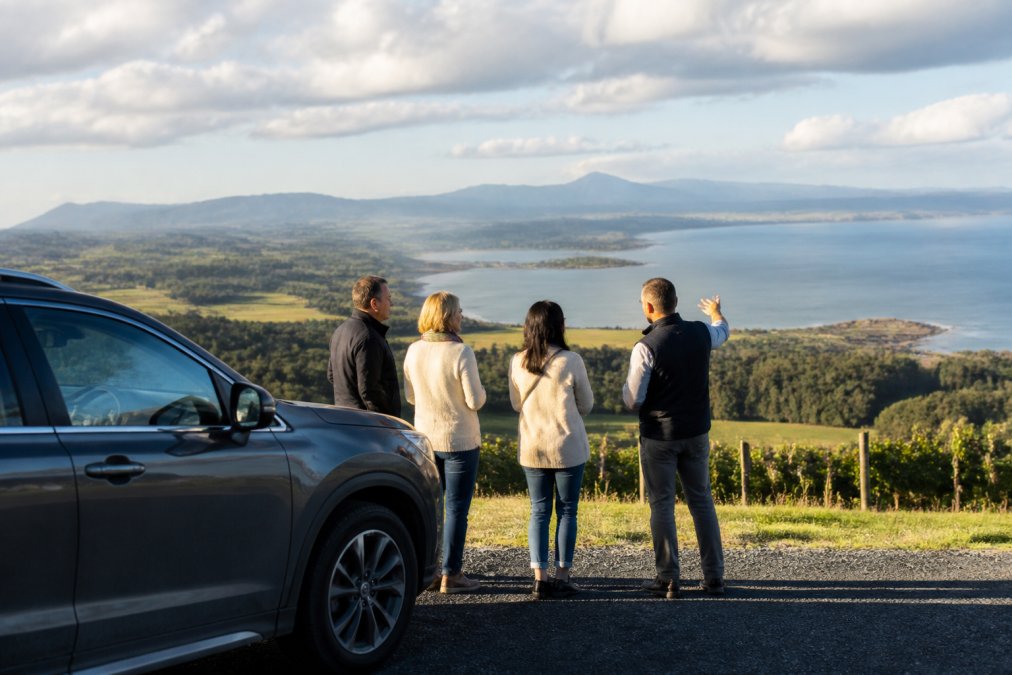
- Timing built around your body clock, not a bus schedule
- Route shaped by your interests, whether that is food, wilderness or history
- Pace that allows unhurried stops instead of rushed photo opportunities
How to Plan a Private Tour in Tasmania: A Step-by-Step Framework
Planning a private tour starts with clarity about what you actually want, then matching logistics to that vision. The process is straightforward when you work through it in order.
- Define your priorities. List the two or three experiences that matter most, such as a winery visit, a wilderness walk or a heritage town.
- Set your group’s realistic pace. Multi-generational groups often need shorter driving legs and more rest stops.
- Choose your base. Decide whether you are staying in one region or moving between them.
- Share your existing plan. If you already have a rough itinerary, a good operator will build around it rather than replace it.
- Confirm logistics early. Pick-up and drop-off points, vehicle size and accessibility needs should be settled before the day.
- Build in flexibility. Leave room for spontaneous stops, because the best moments are rarely scheduled.
Tasmania Tour Guide Pricing: What Affects the Cost of a Private Tour
Tasmania tour guide pricing is quoted per booking, not per seat, which is the single most important thing to understand before you compare operators. A private charter is priced on the vehicle and guide for the day, so the total is largely fixed and the cost per person falls as your group grows. That is the opposite of a coach tour, where the price is per head and the group size is out of your control.
- Duration, a half-day charter, a full-day charter and a multi-day package are priced on different day rates, and multi-day bookings often attract a lower effective daily rate because the vehicle and guide are already committed.
- Group size, a sedan or SUV suits two to four passengers, while larger groups need a people-mover or minibus, which changes both the vehicle cost and, in some cases, licensing requirements.
- Distance and region, a day based around Hobart and the Derwent Valley involves far less driving than a Cradle Mountain or Coles Bay itinerary, and remote regions add fuel, time and guide-hours to the quote.
- Special access, private tastings, after-hours site access, guided walks with a specialist or bookings at high-demand restaurants all carry their own fees on top of the charter.
- Season and demand, peak periods such as summer school holidays and the shoulder weeks around major events tighten vehicle and guide availability, which can push rates up or limit choice.
- Inclusions, entry fees, tastings, lunch and national park passes may be bundled or excluded, and the difference between two quotes is often explained by inclusions rather than the day rate itself.
How private tour pricing scales for solo travellers versus groups
This is where most published guides stay silent, and it matters. A private vehicle has a fixed cost, so a solo traveller effectively pays for the whole vehicle. A common pattern is that solo travellers either accept that premium for full control, or ask the operator to match them into a small group departure on a set date to split the cost.
What to ask for in a written quote
Ask whether the quote includes entry fees, tastings and lunch, and whether it is a fixed day rate or an hourly rate. Operators structure inclusions differently, and a clear breakdown avoids surprises on the day.
For current pricing on a tailored itinerary, request a quote directly from the operator and give them your group size, dates and must-do experiences, the more specific you are, the more accurate the figure will be.
Beyond the Overlooked: Hidden Gems and Accessible Options
Most private itineraries default to the same three names: Cradle Mountain, Wineglass Bay and Hobart. They are genuinely worth seeing, but they are also the busiest, the most weather-dependent and the most likely to be closed or crowded on the day you want them. A good private guide earns their fee by knowing what to do when those three are not the right answer, and by knowing which alternatives genuinely work for travellers with limited mobility.
Lesser-visited regions worth building a day around
Away from the headline sites, several regions reward a private vehicle because public transport is limited or non-existent:
- The Derwent Valley and Central Highlands, heritage towns, hop-growing history and highland lakes, with far fewer coach groups than the east coast.
- The north-west coast and Tarkine edge, temperate rainforest, mining heritage and quiet coastal towns, best done as a long day or an overnight rather than a rushed return trip.
- The Tamar Valley, a compact wine and produce region north of Launceston that suits a slower, tasting-led day.
- The east coast’s inland route, rather than the highway, the back roads through farming country and small settlements give a very different picture of the island.
- The south-east and Huon Valley, orchard country, cider makers and forest walks within reach of Hobart, often overlooked by visitors heading north.
Accessibility and mobility: what actually works
Accessibility is the gap most published guides skip, and it deserves an honest answer rather than a promise. Not every wilderness site suits every traveller, and a good guide will match the route to mobility needs rather than overstate what is possible.
In practice, accessible private touring usually means:
- Boardwalks and formed paths at sites such as the Tamar Island Wetlands, the Hobart waterfront and the Royal Tasmanian Botanical Gardens, which suit wheelchairs, walkers and slower pacing.
- Vehicle choice, a higher-seating SUV or van with a step or ramp makes entry and exit easier than a low sedan, and this should be settled before the day.
- Shorter driving legs with more frequent rest stops, which matters for elderly travellers and anyone managing fatigue.
- Viewpoint-based sightseeing where the scenery is the point, so the day does not depend on a long walk.
- Advance checking of individual site access, because paths, gradients and facilities vary and some sites change access seasonally.
Sustainability and community benefit
Sustainability in private touring is less about a badge and more about how the day is run. Choosing an operator who keeps groups small, avoids sensitive sites at peak times, supports local producers and employs local guides keeps more of the tourism spend in the regions you are visiting. The Global Sustainable Tourism Council criteria sets out the broad principles responsible operators work to, and it is a useful reference when you are comparing claims.
Solo versus small group on these routes
Off-the-beaten-path itineraries are where the solo-versus-group decision bites hardest. A private vehicle gives you full control over where you go and how long you stay, but on a solo booking you are paying for the whole vehicle. A small group splits that cost and can make a lesser-visited region affordable, at the price of some flexibility. There is no universal answer, only the one that fits your budget, your mobility needs and how much control you want over the day.
How to Choose the Best Private Tour Guides for Your Interests
Choosing well comes down to local knowledge, flexibility and honest communication. A guide who genuinely knows the island will tailor the day rather than recite a script.
When comparing operators, ask these questions:
| What to Check | Why It Matters | Red Flag |
|---|---|---|
| Local knowledge | Shapes authentic, flexible routing | Generic, memorised commentary |
| Licensing and insurance | Confirms professional operation | Vague or evasive answers |
| Itinerary flexibility | Shows willingness to adapt | Insistence on a fixed route |
| Accessibility support | Matches route to mobility needs | No discussion of access |
| Sustainability practices | Reflects responsible tourism | No environmental policy |
| Booking flexibility | Protects against plan changes | Rigid, non-negotiable terms |
Frequently Asked Questions
What are the benefits of hiring a private tour guide in Tasmania?
A private tour guide offers a tailored itinerary, flexible pacing, and local expertise that group tours cannot match. You travel in a modern vehicle with pick-up and drop-off at your accommodation, avoid crowded buses, and gain access to hidden gems and providores that mass tourism misses. For multi-generational families or solo travellers, the guide adapts the day to your energy levels and interests, making the experience stress-free and deeply personal.
How much does a private tour guide in Tasmania cost?
Pricing for Tasmania tour guide services depends on group size, duration, season, and the level of customisation. A half-day bespoke tour costs less than a full-day multi-day itinerary, and luxury inclusions such as private charters or exclusive winery visits add to the total. Because every itinerary is tailored, the best approach is to request a personalised quote from your chosen operator based on your specific plans and travel dates.
Can I customise a private tour in Tasmania to include wine, wildlife, and hidden beaches?
Yes. Bespoke Tasmania day tours are built around your interests, whether that means winery visits in the Tamar Valley, wildlife encounters at Cradle Mountain, or secluded beaches along the East Coast. A reputable guide will work with your rough itinerary from guidebooks or social media and refine it, ensuring travel logistics, opening hours, and seasonal conditions are all accounted for without pushing you into a standard route.
Are private tours in Tasmania suitable for families with different mobility needs?
Private tours suit families well because the guide can adjust the pace and choose accessible attractions. For grandparents with mobility assistance needs, operators can select wheelchair-friendly lookouts, short walks, and comfortable vehicles with easy entry. Meanwhile, children might enjoy a wildlife park or a chocolate factory visit. The key is to communicate your group’s requirements during planning so the itinerary balances everyone’s energy levels and interests.
Planning a private tour means trusting someone else with your limited holiday time, and that trust has to be earned. VIP Tassie Experiences builds each day around your interests, with spacious modern vehicles, passionate local guides and no crowded buses or rigid schedules. We work with local businesses to craft authentic, unhurried experiences across the island’s landscapes and hidden gems. Get started with VIP Tassie Experiences and book your tour today.


Experiences
Book a Tour
Plan your tailored Tasmanian journey with ease—reserve your private tour today.


