
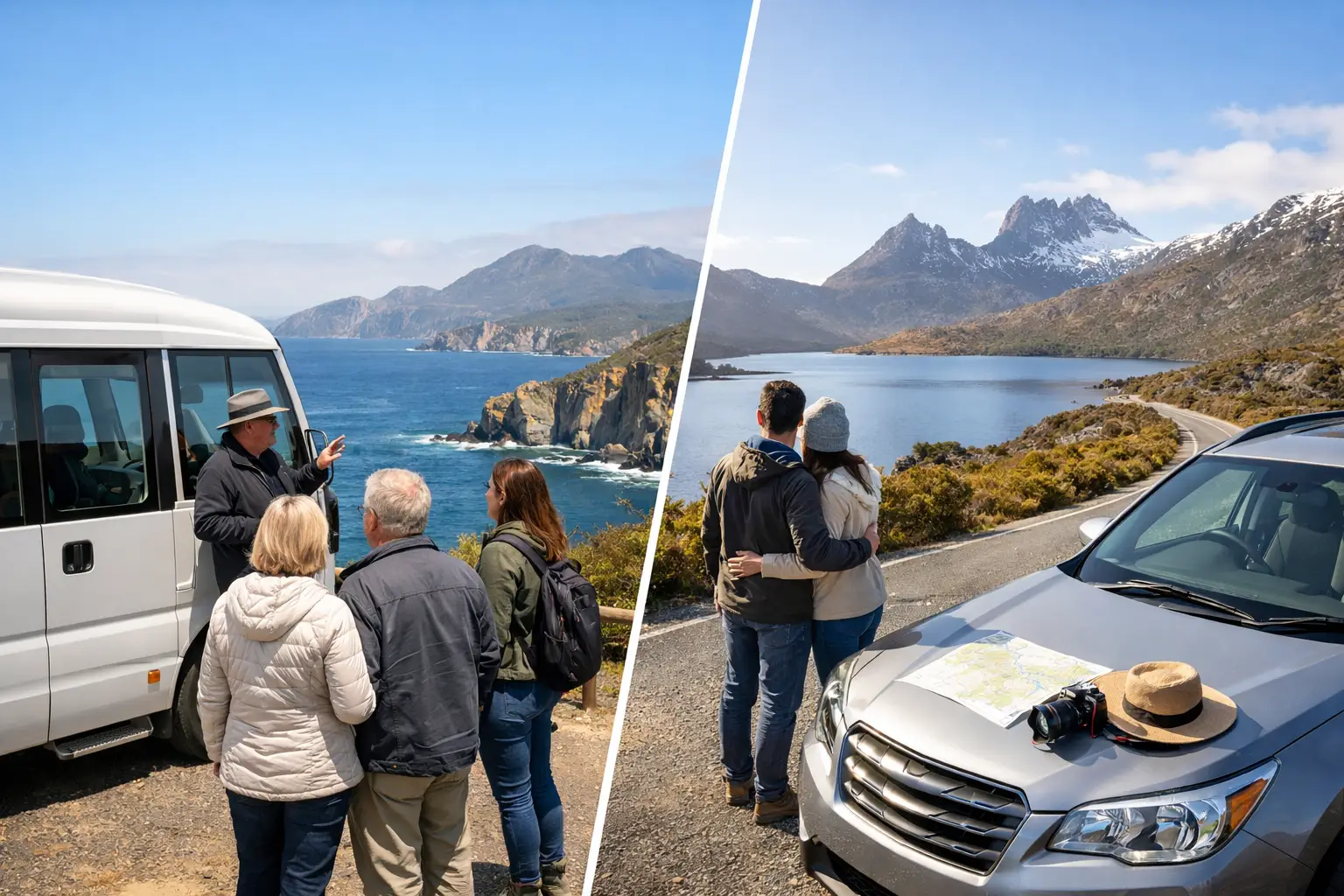
You can tell a lot about a holiday by what happens in the first hour. If you land in Hobart, collect the keys, sort the luggage, study the road rules and start watching the clock, the mood shifts quickly. That is why the question of guided touring or self drive matters more than many travellers expect – especially in a place as layered, beautiful and quietly surprising as Tasmania.
At first glance, self-drive travel seems like the obvious choice. Freedom, spontaneity, your own playlist, a scenic road opening up in front of you. For many people, that sounds ideal. Yet Tasmania is not simply a destination to tick off between lookouts. It is a place of small turns, local conversations, cellar doors without signage fanfare, coastal roads that ask for patience, and experiences that become richer when someone knows where to pause and why it matters.
Guided touring or self drive: what are you really choosing?
This decision is not only about transport. It is about how you want to feel while travelling.
A self-drive holiday tends to suit people who genuinely enjoy the mechanics of travel. They do not mind researching distances, comparing routes, checking parking, and adapting plans when weather or timing changes. The journey itself becomes part of the project, and that can be satisfying.
Guided touring, particularly in a private format, suits travellers who want the experience without the logistical load. The day feels lighter because someone else is quietly taking care of timing, navigation, reservations and local flow. You are not spending mental energy deciding whether a winery stop will affect the afternoon schedule or whether the next heritage site is worth the detour. You simply enjoy it.
For premium travellers, that distinction is often the real one. Not cost versus convenience, but administration versus immersion.
The case for self drive
There are real advantages to self drive, and they should not be dismissed. Tasmania is compact enough to make road travel appealing, and many visitors like the independence of setting their own pace. If you wake up and decide to linger over breakfast, stop at a roadside berry stall, or spend an extra hour on a beach, no one is hurrying you along.
Self drive can also make sense if your trip is highly casual. Perhaps you are returning to familiar regions, travelling on a looser budget, or building in long stretches of time where the destination matters less than simply being away. In those cases, driving yourself can feel natural.
There is also a particular pleasure in private discovery. Pulling over when the light changes across the paddocks, finding a quiet town by chance, or taking the longer road because it looks interesting can be rewarding. Some travellers value that sense of authorship. It gives the holiday a more personal rhythm.
But the freedom of self drive is not pure freedom. It comes bundled with responsibility, and that is where the romantic image can begin to fray.
Where self drive becomes less relaxing
Tasmania rewards curiosity, but it also rewards local knowledge. Distances can look short on a map yet take longer than expected. Roads can be winding. Regional driving after dark is not ideal, particularly where wildlife is active. Parking in busy pockets can interrupt an otherwise lovely day. If wine tasting is on the agenda, someone needs to remain the designated driver.
Then there is the quieter cost: attention. The driver is rarely fully off duty. Even on scenic routes, part of the brain is occupied with navigation, road conditions, arrival times and where to stop next. That may be perfectly acceptable for some travellers. For others, it means the person behind the wheel experiences less of the holiday than everyone else.
Why guided touring feels different
A well-crafted guided tour is not about being herded from stop to stop. In its best form, it feels more like being hosted by someone who knows the island intimately and understands how to shape the day around you.
That matters in Tasmania because so much of its appeal is subtle. A generic itinerary can show you the landmarks. A local guide can reveal context, timing and access that turn a pleasant outing into a memorable one. You might arrive at a vineyard when the light is best and the crowd is gone. You might meet a maker whose story adds meaning to what would otherwise be a simple tasting. You might take a quiet route to avoid the obvious rush and gain a better view along the way.
Private guided touring also changes the pace. There is no coach timetable, no pressure to keep up with strangers, and no need to compress your day into rigid blocks. If a coastal lookout deserves longer, or lunch is too good to rush, the experience can breathe.
Comfort is not a small detail
Luxury travel is often misunderstood as a collection of extras. In reality, comfort changes how a day unfolds. Door-to-door transport, spacious seating, a calm environment, and the ease of not managing every small task create a different kind of holiday energy.
That is especially true for couples celebrating something special, small groups with mixed interests, multi-generational families, or visitors arriving by cruise ship or staying in Hobart without wanting the burden of a hire car. In these situations, guided touring offers more than convenience. It preserves the mood of the trip.
Guided touring or self drive for food, wine and local access
If your travel style leans towards long lunches, cellar doors, artisan produce and meaningful conversations, guided touring usually has the stronger argument.
Self drive can certainly get you to excellent wineries and regional dining rooms. What it cannot always provide is the local insight that helps you choose well. Some of the most rewarding experiences are not the most heavily promoted. They are the places with personality, quality and a story behind them – and they are easier to find when someone local is doing the curating.
There is also the obvious practical benefit. If the day includes wine, whisky or cider, not having to think about driving is a luxury in the truest sense. You can settle in, taste properly and enjoy the region as it is meant to be experienced.
For travellers who want depth rather than just movement, this is often the turning point. A self-drive day may cover ground. A private guided day can reveal character.
The value question people often ask quietly
On paper, self drive can seem less expensive. You compare a hire car with a private tour and assume the answer is straightforward. Sometimes it is. But value is not only about the headline price.
A self-drive itinerary may involve vehicle hire, fuel, insurance, parking, time spent planning, and occasional compromises caused by uncertainty or poor timing. You may choose the wrong lunch spot, miss the best cellar door window, or spend a good part of the day navigating rather than enjoying. None of these are disasters, but they do affect the quality of the experience.
A private guided tour costs more because it includes expertise, comfort, local relationships and the removal of friction. For many travellers, particularly those who have limited time in Tasmania, that is money well spent. A beautifully planned day with the right pacing can feel far more valuable than a cheaper day diluted by logistics.
Which option suits you best?
If you love independence, enjoy planning, are comfortable on regional roads and do not mind being responsible for the structure of each day, self drive may suit you very well. It can be rewarding, flexible and genuinely enjoyable.
If you want your holiday to feel effortless, refined and more deeply connected to place, guided touring is usually the better fit. It allows you to stay present. You notice more. You ask more questions. You have the space to enjoy Tasmania rather than manage it.
For many premium travellers, the best answer is not entirely one or the other. A private guided day or two at the beginning of a trip can provide insight, orientation and extraordinary access, while slower self-drive days later can offer independence once you are familiar with the landscape. It depends on your priorities, your confidence, and how much of the journey you want to personally coordinate.
VIP Tassie Experiences is built around that very idea: that Tasmania is best experienced with comfort, flexibility and local knowledge shaping the day, not just a map and a booking confirmation.
The right choice comes down to what you want to bring home. If it is simply photos and kilometres covered, self drive may do the job nicely. If it is a sense of having been truly looked after, introduced to the island properly and given access to its quieter pleasures, guided touring has a way of staying with you long after the holiday ends.


Experiences
Book a Tour
Plan your tailored Tasmanian journey with ease—reserve your private tour today.


