
Table of Contents
- Why Luxury Private Tours Suit Tasmania Families
- Bespoke Family Itineraries Tasmania: Built Around Your Family
- Multi-Generational Travel Tasmania: Keeping Everyone Happy
- Customised Day Tours for Families: Wildlife, Wilderness and Coast
- Food, Wine and Gourmet Stops for the Whole Family
- What Luxury Private Tours Cost: Budget Transparency for Families
- Frequently Asked Questions
Last Updated: September 28, 2026
Why Luxury Private Tours Suit Tasmania Families
Luxury private tours for Tasmania families solve a problem group travel cannot: everyone moves at their own pace, sees what they actually came for, and never waits for a busload of strangers. At VIP Tassie Experiences, we build private, local-led day tours around one family at a time, in spacious modern vehicles, with no rigid schedules.
What Sets a Private Tour Apart from Group Travel
A private tour is a vehicle, a guide and an itinerary reserved for your group alone. Group travel runs to a fixed timetable; a private day tour bends around your family instead.
The practical differences show up quickly:
- Timing: You leave when you’re ready, not at 8am sharp.
- Routing: Detours to a farm gate, a beach or a bakery cost nothing but a decision.
- Pace: A tired four-year-old and a restless grandfather can both be accommodated.
- Access: Smaller vehicles reach places coaches simply cannot.
How to Choose the Right Operator for Your Family
Look for three things: local guides, a genuine planning conversation before you book, and vehicles that suit your group size.
Ask directly:
- Are your guides locals who live in the region they tour?
- Can you show me a sample itinerary built for a family like mine?
- What happens if we want to change the plan mid-day?
Bespoke Family Itineraries Tasmania: Built Around Your Family
Bespoke means the itinerary starts blank. You bring your rough plan from guidebooks and social media; we work with it rather than replacing it.
A useful structure for a multi-day family visit:
- Day one: Gentle. A nearby heritage town, a long lunch, an early finish.
- Day two: The big wilderness day, while everyone is fresh.
- Day three: Coast, wildlife and a slower pace.
- Day four: Food, wine and providores, with something for the children built in.
Mapping Your Days with Interactive Itinerary Tools
What most guides miss is that drive time is the real constraint, not activity time. A day with four stops an hour apart is a day spent in the car.
Sustainable Luxury: Treading Lightly with Local Providers
Smaller groups, locally owned providores, and guides who know which fragile areas to visit at which hour, so your family sees them without adding to the pressure on them.
Choosing local operators keeps money in regional communities.
Multi-Generational Travel Tasmania: Keeping Everyone Happy
In practice, this means a morning walk for the walkers and a garden, gallery or café for the others, then a shared table at midday. Afternoons stay short. Nobody remembers the day they were exhausted by 3pm.
Pacing, Rest Stops and Energy Levels Across Age Groups
Build rest stops into the plan rather than treating them as failures.
| Age Group | Realistic Active Hours | Best Time of Day | Rest Stop Needs |
|---|---|---|---|
| Under 5 | 2-3 hours | Morning | Every 60-90 minutes |
| 6-12 | 4-5 hours | Morning to early afternoon | Every 2 hours |
| Adults | 6-8 hours | Any | Every 2-3 hours |
| Over 70 | 3-4 hours | Morning or early afternoon | Every 90 minutes |
Customised Day Tours for Families: Wildlife, Wilderness and Coast
Customised day tours for families work best when each day has one headline experience and everything else supports it. Trying to fit wilderness, coast and wildlife into a single day produces a day nobody enjoys.
Cradle Mountain and Wilderness Days
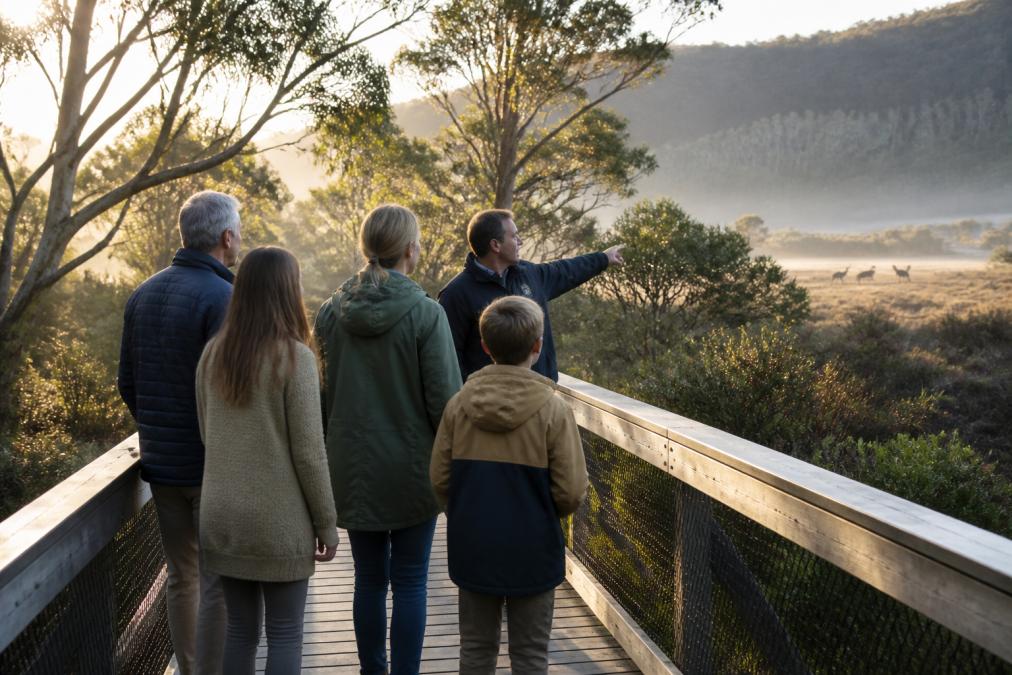
Boardwalk sections around Dove Lake are manageable for most ages, and shorter options let the group split without anyone missing out.
Coastal, Island and Wildlife Encounters
Coastal days are the easiest to get right. Pristine beaches, short walks, and wildlife encounters timed for dawn or dusk, when animals are actually active.
Wildlife conservation is part of the experience here.
One headline experience per day, with everything else arranged around it, is the pattern that keeps multi-generational groups happy across a full itinerary.
Food, Wine and Gourmet Stops for the Whole Family
The state’s cool-climate wine regions, artisan providores and farm-gate experiences are spread across distinct areas, and the difference between a memorable tasting day and a miserable one is usually logistics, not the venues themselves.
The Main Food and Wine Regions, and What Suits Families
- The Tamar Valley (north): Tasmania’s oldest wine region, with cellar doors along a single river road. Many venues have lawns, gardens or restaurants where children can eat while adults taste. The compact geography means short drives between stops.
- The East Coast (Bicheno to Freycinet): Oyster farms, berry farms and seafood shacks sit alongside wineries. This is the easiest region to combine with a beach walk, which is exactly the pattern that keeps younger travellers engaged.
- The Huon Valley and D’Entrecasteaux Channel (south): Apple orchards, cider producers, salmon and cheese makers. Many are working farms, so children see where food comes from rather than just eating it.
- Launceston and surrounds: A dense cluster of providores, distilleries and patisseries within a short drive of the city, ideal for a half-day tasting loop when energy is low.
How to Build a Tasting Day That Works for Three Generations
A common pattern among experienced family travellers is the two-stop rule: no more than two tasting venues in a day, with a substantial activity between them. Beyond two, children disengage and adults stop enjoying the wine because they are managing the children.
A workable structure:
- Late morning: One cellar door or distillery with a garden or lawn. Book ahead and ask whether they offer a children’s platter or non-alcoholic tasting flight.
- Midday: A long lunch at a farm-gate restaurant or providore. This doubles as the rest stop.
- Early afternoon: Something active, a berry farm in season, a cheese maker with animals, or a short coastal walk.
- Optional late afternoon: A second, smaller tasting stop only if the group still has energy.
Practical Details Most Guides Skip
- Book cellar doors in advance. Many smaller producers operate by appointment only, particularly outside peak season, and a private guide can often secure a tasting that walk-ins cannot.
- Ask about licensed premises rules. In Tasmania, children are generally permitted in licensed venues that serve meals, but some smaller cellar doors have restrictions. Confirm when booking.
- Designated driver or private guide. If adults intend to taste properly, a private guide removes the question entirely. This is one of the clearest practical arguments for a private tour over self-drive.
- Seasonality matters. Berry farms peak in summer; apple and cider experiences peak in autumn; oyster farms operate year-round but some close on certain days. A good operator builds the day around what is actually open and in season.
Ask your operator to build the tasting day around one named producer your family is excited about, then fill the rest of the day around it. It gives the day a centre of gravity and stops it becoming a blur of similar cellar doors.
Pairing Food with the Rest of the Itinerary
Put the tasting stop mid-afternoon rather than at the end of a long day, and pair it with something active nearby.
What Luxury Private Tours Cost: Budget Transparency for Families
This section gives you the honest structure of how pricing works, so you can judge fit before you enquire.
How Private Tour Pricing Is Structured
A private day tour is quoted per vehicle, not per person. That single fact changes the maths for families: the cost per head falls sharply as your group grows. A family of four pays roughly half per person what a couple pays for the same vehicle and guide.
The Five Factors That Drive the Quote
- Group size and vehicle. A family of four fits a standard SUV or people-mover. A multi-generational group of seven or eight needs a larger vehicle, which raises the base cost but lowers the per-head figure.
- Distance and region. A day based around Hobart or Launceston covers less ground than a Cradle Mountain or East Coast day. Remote wilderness days carry higher vehicle and guide-time costs.
- Duration. Half-day, full-day and multi-day tours price differently.
- Inclusions. Entry fees, tastings, meals and national park passes can be bundled into the quote or left out.
- Season. Peak periods, summer school holidays, and the Cradle Mountain walking season, book out earlier. Shoulder season offers more availability.
What Families Should Expect to Pay
Because every itinerary is built from scratch, there is no single figure. What we can say is that private day tours are a premium product. The trade-off is that you are buying the vehicle, the guide and the itinerary for your group alone.
Ways to Manage the Budget Without Losing the Luxury
- Mix half-days and full days. Use a half-day private tour on arrival or departure days and full days for the headline experiences. You keep the private format where it matters most.
- Book multi-day rather than multiple single days. The per-day rate is usually lower and the guide learns your family’s rhythm.
- Travel in shoulder season. Availability improves and pricing softens, with little loss of experience outside the peak wilderness window.
- Be specific about inclusions. If your family will not use every tasting or entry, ask for a quote that excludes them.
- Share the vehicle across generations. A multi-generational group of six to eight often pays less per head than two smaller family groups booking separately.
For current rates, contact VIP Tassie Experiences directly with your group size, dates and rough plans, and we will give you a clear starting figure before you commit to anything.
Frequently Asked Questions
Are private tours in Tasmania suitable for young children?
Yes. Luxury private tours are built around your family’s pace, so young children can stop for naps, snacks and play breaks without disrupting a group schedule. Operators supply child seats and family-friendly vehicles on request. Days can be shortened or reshaped mid-tour if little ones tire. This flexibility is one of the main reasons families choose private over group travel.
Can luxury tours in Tasmania be customised for multi-generational groups?
Multi-generational travel Tasmania is a core strength of bespoke touring. Guides plan shorter walking segments for grandparents, hands-on wildlife activities for children, and wine or providore stops for adults, all within one day. Vehicles are spacious enough for mobility aids, prams and gear. The itinerary can run at a gentler pace with frequent seated breaks, so every generation stays comfortable and engaged.
What is the best time of year to visit for a family-friendly luxury tour?
Summer (December to February) offers the warmest days and longest daylight, ideal for wilderness and coastal days with children. Autumn (March to May) brings calm weather and vivid colours, which suits wine and food-focused itineraries. Spring (September to November) is quieter and wildflower-rich. Winter (June to August) works for those who want cosy heritage and culinary days. Each season shapes what a bespoke itinerary can include.
How much do luxury private tours for Tasmania families cost?
Pricing depends on group size, duration, vehicle type and the experiences included, so there is no single figure. A full-day private tour with a local guide, premium vehicle and gourmet stops costs more than a half-day scenic drive. Multi-day packages and exclusive-use arrangements also change the total. For accurate current pricing, request a personalised quote directly from the operator.


Experiences
Book a Tour
Plan your tailored Tasmanian journey with ease—reserve your private tour today.


