
A wombat crossing a quiet roadside at dusk is one of Tasmania’s great privileges, but it is never a moment to rush. The best encounters with Tasmanian wildlife tend to happen when the schedule softens: a wallaby pauses in the bracken, a wedge-tailed eagle turns above a valley, or a tiny pademelon appears at the edge of the forest just as the light begins to fade.
For travellers who value more than a quick photograph, wildlife here offers a different kind of luxury. It asks for patience, a little local knowledge and the freedom to linger in the right place at the right time. In return, Tasmania reveals an ancient, wonderfully distinctive world of animals shaped by island isolation, cool forests and wild coastlines.
Why Tasmanian wildlife feels so close
Tasmania has an intimacy that makes wildlife encounters feel personal. Native animals are present across the island, from coastal heath and farmland edges to temperate rainforest and high alpine country. You need not be deep in a remote national park to see movement in the bush.
That accessibility should not be mistaken for predictability. A private, unhurried approach is far more rewarding than chasing a checklist. Seasons, weather, time of day and recent human activity all influence what may be seen. A quiet morning after rain can be ideal for birds and forest-dwelling mammals, while dusk often brings out the island’s more elusive marsupials.
It also pays to distinguish between seeing an animal and truly observing it. Watching a wombat methodically feed in open grassland, or listening for the calls of frogs beside a still wetland, creates a far stronger memory than crowding close for a hurried image.
The animals visitors hope to meet
Wombats, wallabies and pademelons
The common wombat is perhaps Tasmania’s most endearing ambassador. Stocky, solitary and surprisingly purposeful, wombats are most often active from late afternoon through the night. They can be seen in suitable open country around several national parks and rural districts, particularly where forest meets grassland.
Bennett’s wallabies are familiar across much of the island, though their calm appearance should never invite feeding or close approach. Their smaller relative, the Tasmanian pademelon, favours thicker cover and is especially enchanting when it emerges quietly from the undergrowth. Both are at their most active around dawn and dusk.
The practical consideration is road safety. Many animals move at twilight, precisely when visibility begins to drop. A considered itinerary allows time to be in the right area before dusk, then returns at a measured pace rather than turning a wildlife sighting into a hurried drive after dark.
Tasmanian devils and quolls
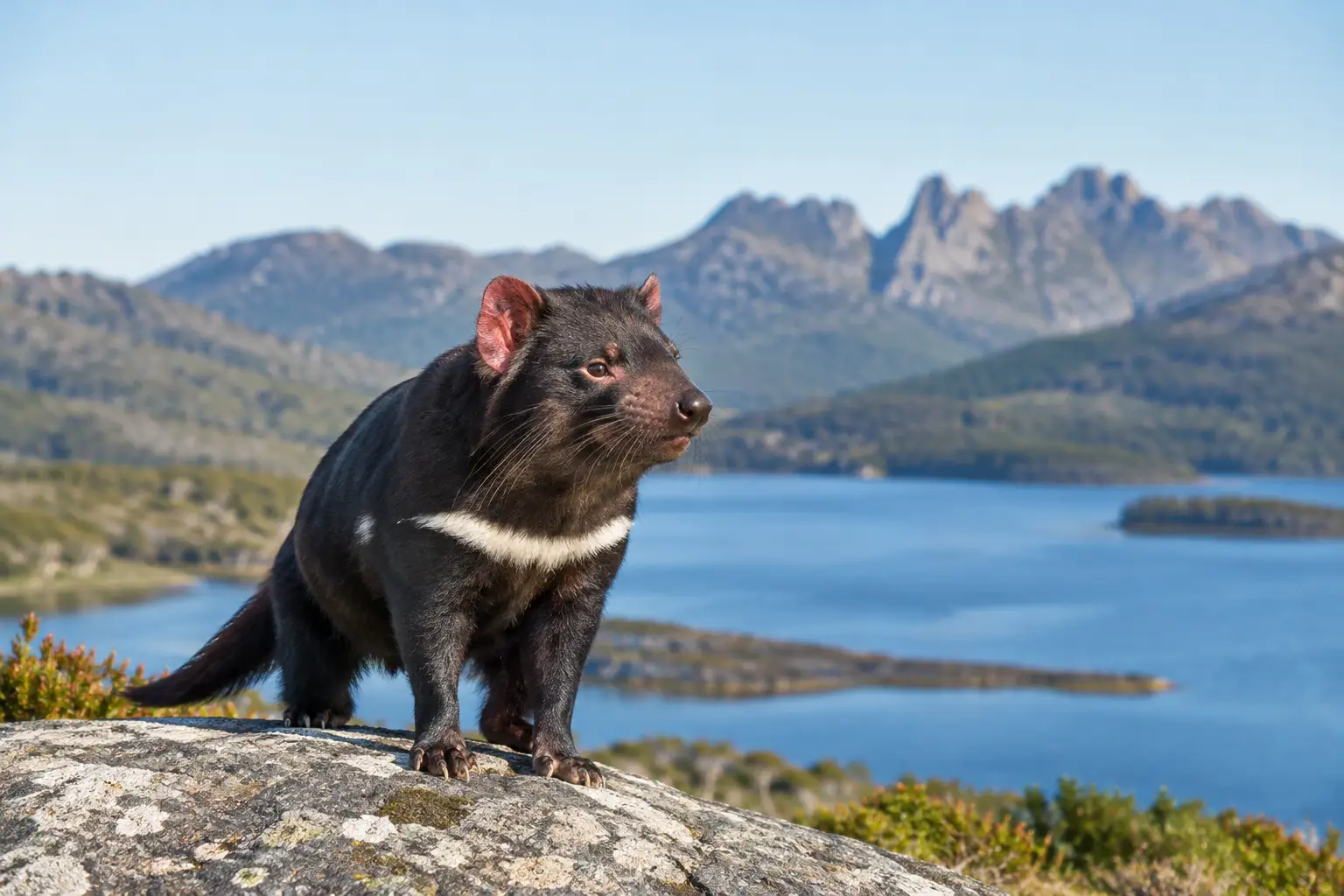
The Tasmanian devil holds understandable fascination. Its powerful build, expressive ears and famously forceful vocalisations are unlike anything else in Australia. Yet devils are mostly nocturnal, and a genuinely wild sighting is never something that can be promised.
For some visitors, a carefully chosen wildlife sanctuary offers the most reliable opportunity to understand devils and the conservation work supporting them. For others, the possibility of a fleeting wild encounter is part of the appeal. These are different experiences, and both have merit. A sanctuary can provide closer interpretation; time spent in appropriate wild habitat offers the rarer thrill of uncertainty.
Spotted-tail quolls and eastern quolls are even harder to encounter. They are beautiful, secretive predators, best appreciated as a reminder that Tasmania’s ecosystems still hold mysteries beyond the obvious favourites.
Birds of forest, coast and open country
Tasmania rewards birdwatchers without requiring specialist expertise. The black currawong’s call carries through mountain forests, while green rosellas add flashes of colour to woodland clearings. Along the coast, look for oystercatchers working the shoreline, sea eagles overhead and, with luck, migratory shorebirds resting in sheltered estuaries.
The Tasmanian wedge-tailed eagle is a particularly memorable sight. Larger and darker than its mainland counterpart, it is a protected species that needs space. Viewing from a respectful distance is not merely good etiquette, but vital to avoiding disturbance near nests and feeding areas.
Those with a particular interest in birdlife may wish to shape a day around wetlands, forest edges or a specific coastal stretch. This is where flexibility matters. A guide who notices the conditions, adapts the route and is content to wait can transform a pleasant walk into a remarkable wildlife experience.
Where to look, without turning nature into a checklist
Different landscapes invite different encounters. The eastern coast, including the Freycinet region, pairs dramatic granite scenery with coastal birds, wallabies and occasional marine life. Bruny Island offers rich opportunities for birdlife, forest species and shoreline observation, particularly when explored at a relaxed pace outside the busiest moments of the day.
The Derwent Valley and Mount Field area combine towering forest, riverside habitats and open country where wallabies, pademelons and birds may be seen. Further north and west, the landscapes become more rugged and remote. Cradle Mountain and its surrounds can be exceptional for alpine species and wombats, although weather can change quickly and wildlife should always take second place to safe conditions.
Around Hobart, even a thoughtfully timed outing can bring rewarding sightings. The bushland slopes of kunanyi / Mount Wellington, nearby wetlands and quieter coastal margins offer a reminder that Tasmania’s natural life is woven into the everyday landscape.
The ideal destination depends on your interests. A couple hoping to photograph birds may favour a gentle morning by the water. A family may prefer a sanctuary visit combined with an easy forest walk. Travellers who have already seen the headline animals might find their greatest pleasure in smaller encounters: echidnas foraging among leaf litter, a platypus ripple on a quiet river, or an unexpected birdcall in the trees.
How to observe wildlife with care
Wildlife tourism is at its best when the animal’s welfare sets the terms. Keep a generous distance, remain quiet and allow animals a clear path away. Never feed native animals, even when they appear accustomed to people. Human food can harm them, alter their behaviour and draw them dangerously close to roads and busy areas.
Photography deserves the same restraint. Long lenses are preferable to stepping closer, flash should be avoided at night, and any animal showing signs of distress should be left alone. If a creature stops feeding, repeatedly looks towards you, changes direction or retreats, you are too close.
Night viewing requires particular judgement. Headlights, torches and noise can disrupt animals at the very time they need to forage. When travelling by vehicle, drive slowly and stay alert, particularly near forest edges and open paddocks. Tasmania’s roads are part of the wildlife habitat, not simply the route between attractions.
A local guide can make this easier without making the experience feel managed. The value lies in knowing when to pause, where conditions are favourable and when a sighting should be left undisturbed. On a private day with VIP Tassie Experiences, the pace can be shaped around those moments rather than the timetable of a large coach group.
The value of allowing time
The most polished wildlife day is not necessarily the one with the greatest number of sightings. It is the one that leaves room for the unplanned: morning mist lifting from a valley, a change in weather that brings birds closer to shelter, or a quiet roadside stop that becomes the highlight of the journey.
Tasmania rewards travellers who trade urgency for attention. Set out early when it suits the landscape, travel comfortably, pause often and let the island reveal itself on its own terms. That is how wildlife encounters become more than photographs – they become part of the story you carry home.


Experiences
Book a Tour
Plan your tailored Tasmanian journey with ease—reserve your private tour today.


